
What is Ethereum?
Ethereum is just a copy of Bitcoin?

A lot of people hold Ethereum without fully understanding what they own. The same was true for Bitcoin. I wrote a whole article on that if you missed it →
What is Bitcoin?

Hi everyone, I decided to start a series of educational posts because I see a lot of misconceptions going around, especially around Bitcoin.
But here is the thing…it does not matter which asset you hold; if you do not understand what you own, you will panic sell the moment it drops.
With Ethereum, the misconceptions run deep. Some think it competes with Bitcoin. Some think it is just another digital currency and cannot figure out why there are thousands of them. Some think it is only for NFTs and speculation. Some heard it has no supply cap and wrote it off entirely.
All of these miss the point. Let me break it down.
How It All Started
In 2015, a 21-year-old programmer named Vitalik Buterin launched Ethereum alongside a small team.
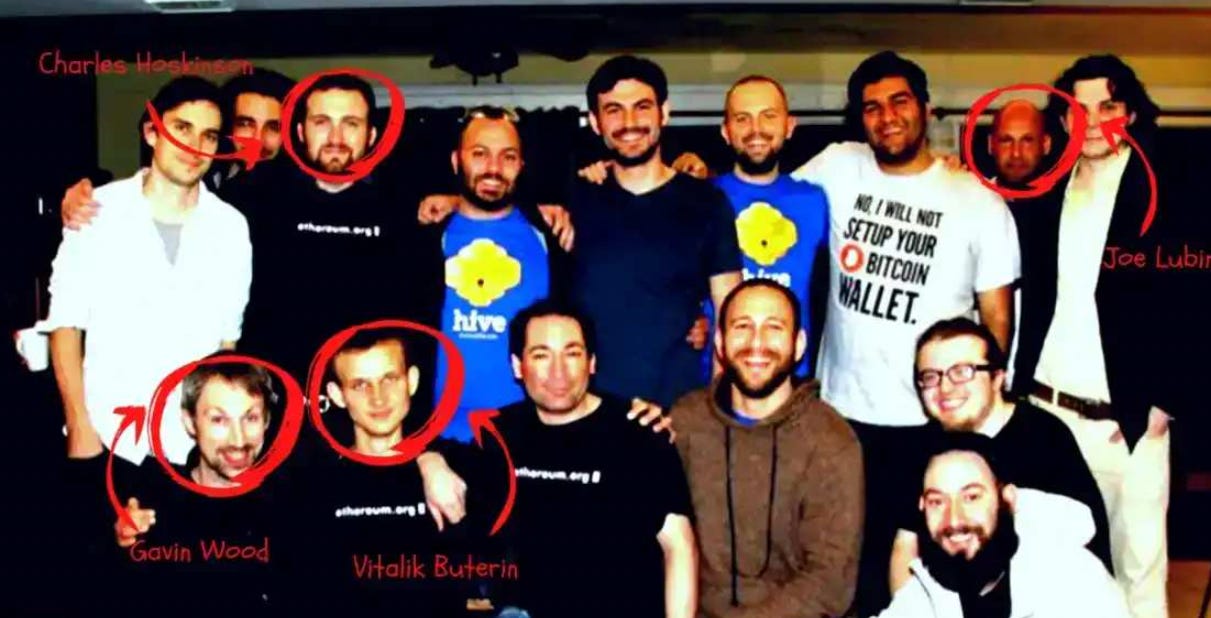
Bitcoin had already proven something radical: money can exist without banks. Vitalik read the Bitcoin whitepaper as a teenager and immediately understood its potential. But he also saw its limits. Back then, many believed that the Bitcoin protocol could not scale. I disagree with that, but that is a topic for another article.
Bitcoin was designed to do one thing extremely well: be decentralized, censorship-resistant money. Vitalik wanted to go further. He proposed adding a programming layer so the blockchain could run any kind of application, not just transfer money. The Bitcoin developer community said no. They wanted to keep the protocol simple and focused. So Vitalik built something new.
The Ethereum whitepaper came out in 2013. The network went live in 2015.
What is Ethereum Really?
Ethereum is digital infrastructure.
Think of it this way. The internet did not just give us a faster way to send letters. It created a new foundation for websites, apps, and whole new industries. Ethereum aims to do the same for money, ownership, and agreements.
Its biggest breakthrough is smart contracts. Simple programs that live on the blockchain and run automatically. No bank. No lawyer. If the conditions are met, the code does exactly what it says.
This lets people build apps for finance, marketplaces, and communities without a company in control that can shut things down or take big fees.
$ETH currency that you hold is the fuel. Every time you use the network, send money, use an app, or run a program, you pay a small fee in $ETH. The more the network is used, the more demand there is for $ETH.
In the end, Ethereum is not just another cryptocurrency. It is infrastructure for a different kind of internet. One where you do not just scroll and post. You OWN. Your money, your data, your stake in the networks you use. That shift is what Ethereum is built for.
Important Differences From Bitcoin
This is where most people get confused.
Both Bitcoin and Ethereum are open, permissionless protocols. Both were created to reduce reliance on middlemen and give power back to individuals. Bitcoin is the protocol built for sound, decentralized money. Fixed supply of 21 million. Extremely secure. Simple by design and very hard to change. It was built to work as real money people can actually use, not just hold. Read → What is Bitcoin?
Ethereum is the protocol built for programmable infrastructure. Smart contracts that let developers build financial tools, ownership systems, marketplaces, and communities without any company controlling them.
Bitcoin keeps things minimal to maximize security and decentralization. Ethereum adds complexity and regular upgrades to enable far more functionality. Different trade-off, different purpose.
Bitcoin fans say Ethereum is too complicated and less pure. Ethereum fans say Bitcoin is too rigid and limited. Both criticisms have some truth to them.
I lean Bitcoin maxi myself. I believe Bitcoin is the strongest base layer money. But I’m not tribal. My goal is simple: make money.
I see Ethereum as a valuable asset with real use cases and upside. That’s why I hold 10-15% of my portfolio in ETH. Both can coexist in a portfolio.
They solve different problems inside the same broader movement.
Common Myths Debunked
Myth 1: Ethereum is just a copy of Bitcoin.
False. Bitcoin came first, and yes, it inspired Vitalik. He read the whitepaper as a teenager and saw its potential immediately. But he also saw what it was not built to do. When he proposed expanding the protocol, the Bitcoin developer community said no. So he built something new from scratch. Different design, different consensus mechanism, no fixed supply cap, fully programmable. The only thing they share is the blockchain concept. One inspired the other. That does not make them the same thing.
Myth 2: ETH has no supply limit so it will inflate forever.
Partially wrong. There is no hard cap like Bitcoin’s 21 million. But in 2021, Ethereum introduced EIP-1559, which burns a portion of ETH with every transaction. Then in September 2022, Ethereum moved from proof-of-work to proof-of-stake, called The Merge, which dramatically reduced how much new ETH gets created each year.
The result: during periods of high network activity, more ETH gets burned than created. The supply actually shrinks. Ethereum can be deflationary.
Myth 3: Gas fees are always insanely high.
This was true in 2021. It is not true today.
A major upgrade called Dencun launched in March 2024 and cut fees dramatically on Layer 2 networks built on top of Ethereum. Many of you already use Base, which is where we invest in a lot of the projects I cover. On Base right now, a simple transaction costs around $0.01. A token swap costs $0.05 to $0.15. Complex DeFi interactions run $0.10 to $0.30 at most. These are not typos.
Most people using Ethereum today are not transacting on the expensive base layer. They use faster, cheaper layers like Base, Arbitrum, and Optimism that still settle on Ethereum for security.
Myth 4: It is only for DeFi speculation and NFTs.
No. People use Ethereum every day to send money internationally, earn yield on savings, and access financial tools their banks simply do not offer.
NFTs and DeFi get the headlines. The boring infrastructure use cases are where the real adoption is building.
Myth 5: It is too slow.
The base layer is intentionally not built for speed. Security and decentralization come first. Speed lives on the Layer 2 networks built on top, and those are fast. Transactions on Base confirm in about one to two seconds and cost almost nothing.
What Can You Actually Do With Ethereum?
Send money anywhere in the world without a bank touching it.
Stake your ETH and earn yield just for holding, currently around 3 to 4 percent annually.
Use DeFi apps for lending, borrowing, and trading without intermediaries.
Hold stablecoins like USDC and USDT, which run primarily on Ethereum.
Own tokenized real-world assets, which institutions are actively building on Ethereum right now.
Where This Is All Going
Ethereum is not a finished product. It is a platform that keeps improving.
The upgrades over the last three years have been significant. Fees are down. Scalability is dramatically better. Energy consumption dropped by over 99 % after the merge.
More importantly, most of what crypto is becoming in 2026 runs on Ethereum or Ethereum-compatible infrastructure. Stablecoins, institutional tokenization, onchain identity, real-world asset markets. Builders chose Ethereum because it has the deepest security, the largest developer community, and the most established ecosystem.
When you hold ETH, you are not just speculating on a price. You are holding a stake in the infrastructure layer of the decentralized financial system being built right now.
Do you hold Ethereum? What part is still confusing? Drop your questions in the comments, and I will break them down.